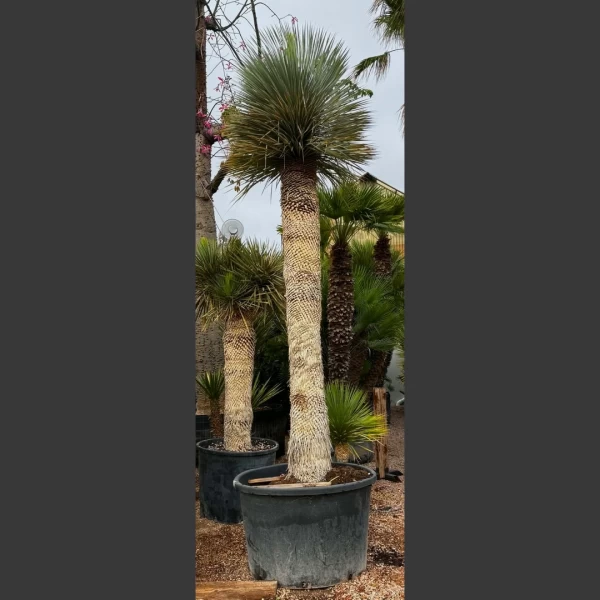
Yucca rostrata also known as "beaked yucca" is an evergreen plant that stands out for its resilience and striking appearance.
Description: Yucca rostrata can reach a height of 2 to 4.5 meters, with its trunk slowly increasing in size over the years. Its leaves are narrow, sword-shaped, measuring about 30-90 cm in length and 1-2.5 cm in width. The plant's trunk is thick, woody, and may branch over time, forming a multi-branched tree. The flowers are large, white or creamy, and appear on tall, upright stalks that can reach up to 90-120 cm above the foliage. It typically blooms in spring or summer.
Origin: Yucca rostrata is native to northern Mexico and the southwestern United States, particularly in the Texas region. It is cultivated in many parts of the world as an ornamental plant, especially in dry, sunny climates.
Requirements: It thrives in dry, warm climates and is highly drought-tolerant. It can survive in areas with very high temperatures and low rainfall. It prefers well-drained soils, such as sandy or rocky ones, and is tolerant of poor, nutrient-deficient soils. Yucca rostrata is resistant to extreme temperatures and can withstand mild frosts (down to about -12°C), making it suitable for cultivation in various temperate or dry regions.
Uses: It is widely used in xeriscaping and landscapes where drought and low maintenance are important. Its impressive form makes it ideal for use as a focal point in gardens and architectural landscapes. It is an excellent choice for areas with drought and low rainfall.
It grows slowly and is sensitive to excessive moisture, which can lead to root rot, so it is essential for the soil to drain well.

Yucca rostrata | YR008

Yucca rostrata | YR009

Yucca rostrata | YR010
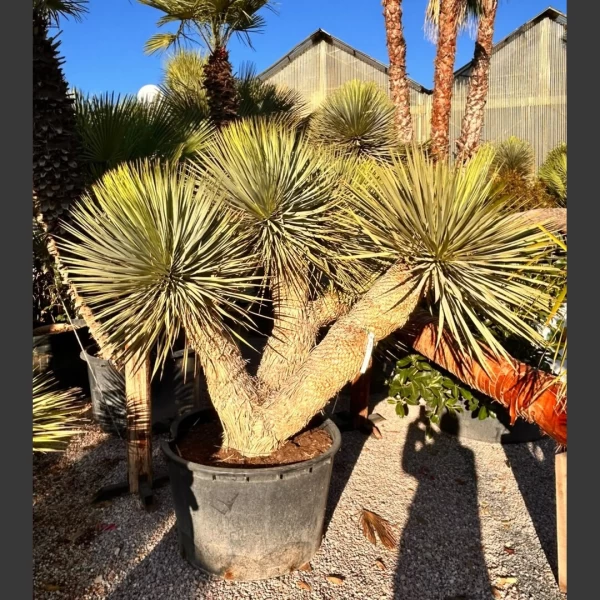
Yucca rostrata | YR011

Yucca rostrata | YR012

Yucca rostrata | YR013

Yucca rostrata | YR015

Yucca rostrata | YR016

Yucca rostrata | YR017

Yucca rostrata | YR018