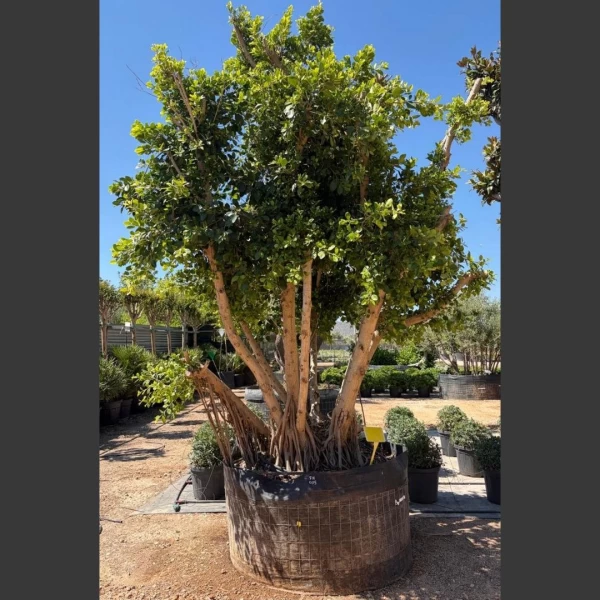
Ficus nitida, commonly known as the Indian Laurel Fig or the "Rhoditian Fig," is a popular tree belonging to the Moraceae family. Here are key details about this plant:
Description: Indian Laurel Fig can grow up to 10-15 meters in height, although it may be smaller in some conditions. Its leaves are leathery, elliptical, or lance-shaped, measuring about 6-12 centimeters in length. They are dark green, glossy, and dense. The tree’s flowers are small and not very noticeable, but they produce small, round fruits that are green when unripe and turn red or black as they mature.
Origin: The tree is native to tropical Asia, with a strong presence in India, China, and Thailand. However, it has spread to other tropical and subtropical regions, including the Mediterranean countries and the southern United States.
Requirements: Indian Laurel Fig thrives in tropical and subtropical climates and can withstand warm, humid environments. It is heat-tolerant but does not fare well in cold temperatures. The tree prefers well-drained soils but can survive in various soil types, including calcareous (limestone) soils.
Uses: This tree is widely used as an ornamental plant in gardens, parks, and urban areas due to its dense foliage and resilience to air pollution. It is often planted for shade and as a windbreak because of its thick canopy.
Ficus nitida is a hardy and versatile tree, ideal for urban and outdoor settings. However, it requires careful maintenance to ensure optimal growth and to avoid potential environmental issues, such as aggressive root systems that can damage sidewalks and infrastructure if not managed properly.

Ficus nitida | FN001

Ficus nitida | FN002

Ficus nitida | FN003